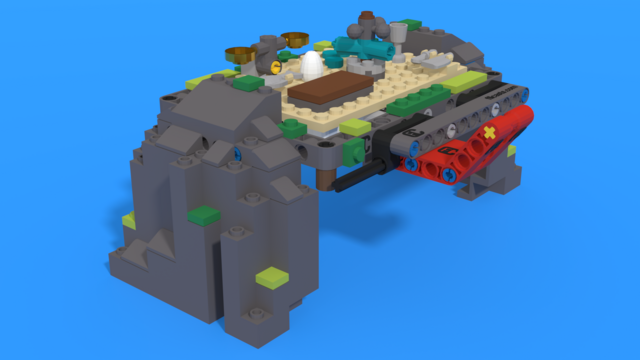
FLL 2022: Bag 11 - Instructions for M11 Hyrdoelectric dam - FIRSTLEGO League 2022-2023 SUPERPOWERED
3D Building instructions for the FIRSTLEGO League 2022 mission model called Hydroelectric dam. Find the parts in Bag 11
- #1580
- 09 Aug 2022
3D Building instructions for the FIRSTLEGO League 2022 mission model called Hydroelectric dam. Find the parts in Bag 11
Introducing Kufar! In Bulgarian, Kufar means "suitcase," and just like a suitcase, this robot is easy to "pack" with different attachments for each task.
Unlike traditional box robots, Kufar is an "out-of-box" design, enabling fast, easy attachment swaps. This flexibility allows teams to build a new chassis with customized attachments for each run, making transitions quick but requiring more parts and careful handling due to its gear transmission, which can sometimes cause gear slippage or play.
To improve precision, Kufar’s gear transmission is optimized for lower speeds. Kufar also includes a color sensor to detect specific colored bricks on attachments and a force sensor to start corresponding programs. With two motors for movement and one for attachments, Kufar is compact, efficient, and easy to handle, especially with its sturdy top handle.
We thoroughly enjoyed exploring this innovative concept and hope you find it equally fun and inspiring!
This attachment is accomplishing three missions and partly one more mission from the FIRST LEGO League 2022-2023. It is for the Chain Monster robot. It solve mission 6 - HYBRID CAR, mission 14 - TOY FACTORY and mission 15 - RECHARGEABLE BATTERY. It partially solves mission 2 - OIL PLATFORM.
This attachment is a great example for a precise drop attachment. It is designed for the Kriket Box Robot and accomplishes the M14 Toy Factory mission from the FIRST LEGO League 2022-2023 SUPER POWERED competition.
This is an active attachment with gears built from LEGO Education SPIKE Prime robotics set. The goal is to do a precise drop. The attachment could be used for both cargo items.
3D instructions for the Energy Storage mission from the FIRST LEGO League 2022-2023 mission model. Parts are in Bag 4 from the set
The orange connector is part of the Smart Grid mission. These are 3D building instructions for the mission model. Parts are located in Bag 5
The Hybrid car and the Ramp are part of mission 6 from FLL 2022. Find the parts in Bag 6 and assembly the model following this 3D building instructions
3D building instructions for the Power plant mission model from the FIRST LEGO League 2022 SUPERPOWERED competition. Find the parts in Bag 10
These are instructions on how to build the:
You can find more building instructions and tips and tricks about the competition at this page.
This is a LEGO Education SPIKE Prime robot attachment for accomplishing the FIRST LEGO League 2020 Bench mission . The attachment is designed for Gazon, LEGO Education SPIKE Prime competition robot.
These are instructions on how to build the:
You can find more building instructions and tips and tricks about the competition on this page.
These are instructions on how to build the:
for the FIRST LEGO League 2019-2020 City Shaper Challenge.
You can find more building instructions and tips and tricks about the competition on this page.
FIRST® LEGO® League mission requirements need to be achieved by your robot through its programs and its use of equipment. You’re allowed to hand-rescue your robot, but that does cause this penalty. Be sure to pay extra attention to the rules where they talk about “Interruptions"
(mission descriptions source https://www.first-lego-league.org/)
Building instructions for this LEGO Mindstorms EV3 attachment for the FIRST LEGO League Nature's Fury robotics competition
This attachment for the Nautiq robot is designed to accomplish M10 Send over the Submersible in the FIRST LEGO League 2024‑2025 SUBMERGED competition. It uses a gear mechanism to lift a LEGO axle, allowing the submarine to slide to the other side.
A FIRST LEGO League 2023-2024 attachment for the MiniBox Robot.
This attachment is designed to detach, once it completes its purpose. This is done, so that the team loses less time switching attachments in the base, lowering the chance of human error during the competition.