
Improving FLL Robot Game. Task. Lift your robot with 40 teeth gear wheels.
Build a similar mechanism to this one. Similar, but for your robot. This is the task for you. Try, give yourself half and hour or even an hour.
- #445
- 06 Mar 2017
Build a similar mechanism to this one. Similar, but for your robot. This is the task for you. Try, give yourself half and hour or even an hour.


Lifting a loop is one of the most common missions in different robotics competitions. In this video we demonstrate how we could do "Vertical lift". It is suitable for precise lifting especially when the mission model requires you to lift straight up. The robot attachment could be adapted to other missions at FIRST LEGO League/World Robotics Olympiad and other robotics competitions that require push/pull. The principle is the same. The tutorial uses Luly, a small LEGO Education SPIKE Prime competition robot with 3D building instructions as a robot base.

In this video we are also focusing on lifting a loop as a common mission on robotics competitions like FIRST LEGO League/World Robotics Olympiad. We demonstrated an attachment for lifting a loop. The tutorial uses Luly, a small LEGO Education SPIKE Prime competition robot with 3D building instructions as a robot base.

Oil is a non-renewable energy source that can be used to provide fuel for vehicles.
Pump the oil so that the fuel units load into the fuel truck, and then deliver the fuel truck to the fueling station.


Attachment for lifting object, especially hex balls if you have them from the Crossover competition.

This robot extends the Tetrix Box Robot chassis for FTC competitions with an additional arm. The arm could be used for lifting and placing objects and could be quite useful.
There is a special rubber band at the end of the arm, because there are not enough parts in the Tetrix set and we had to use a rubber band. But the principle of the arm is interesting, useful and you should be familiar with it - the arm keeps the motors always in the right orientation.

Building instructions for a LEGO Mindstorms Robot that cleans the landing site when landing on a different planet. Built from an EV3 set it is a perfect simple tank robot with continuous tracks for lifting and moving things. Basically cleaning.

The Bench mission in FIRST LEGO League 2020 was one of the more complex missions during the competition. It involved two things - lifting part of the mission model and bringing it back to base and in the same time dropping 4 different boxes which was difficult to achieve. We came up with two solutions for SPIKE Prime and for Robot Inventor and this is the Robot Inventor solution. Take a look. You will learn how to build complex attachments doing more than one thing at a time.

This is an attachment for the top of the robot and the attachment is used for lifting different parts. It is reusable as we could change the lever and use the attachment for a number of different missions.
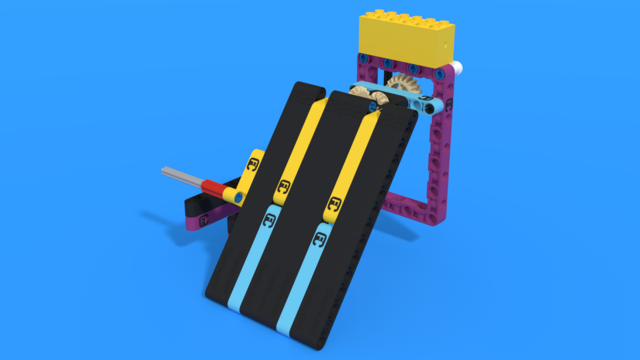
This attachment for the Nautiq robot is designed to lift the coral for M01 Coral Nursery from the FIRST LEGO League 2024‑2025 SUBMERGED competition. It performs two actions simultaneously: lifting the mission model loop and opening the door that holds the Reef Segments.

Previously we caught the Truck with two rubber bands. The next step was to lift it. For lifting we used the Medium LEGO Mindstorms EV3 motors. In this video we are extending the attachment so that we could catch also the Ambulance. In forth video we would explore how to release both vehicles after transporting them.

(LEGO humans of course, not real humans :) ). Working on World Robotics Olympiad 2014 elementary challenge. Collecting modules, bringing them together and lifting them. A very funny and interesting competition that we would explore in this and the next video tutorials from the series

It this episode we would present you with our attachment for lifting the robot.

This is a teacher's note about the math behind calculating gear ratios with for our lifting attachment. It math model we build in previous tutorials is not exactly correct and here is the explanation why.

How great is the great attachment for lifting that we built in this course? How many times can it lift the robot without making an error? How great are your attachments and how could you test them? - the answer is simple. Just try 10 times and they should work at least 9 of them as our attachment is.